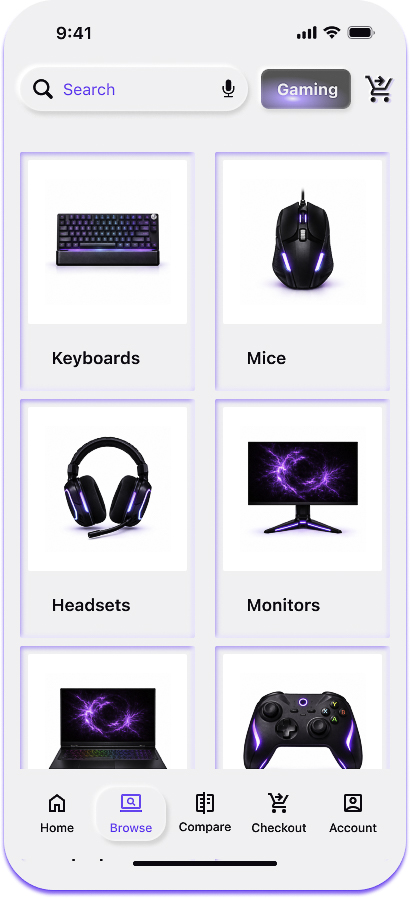
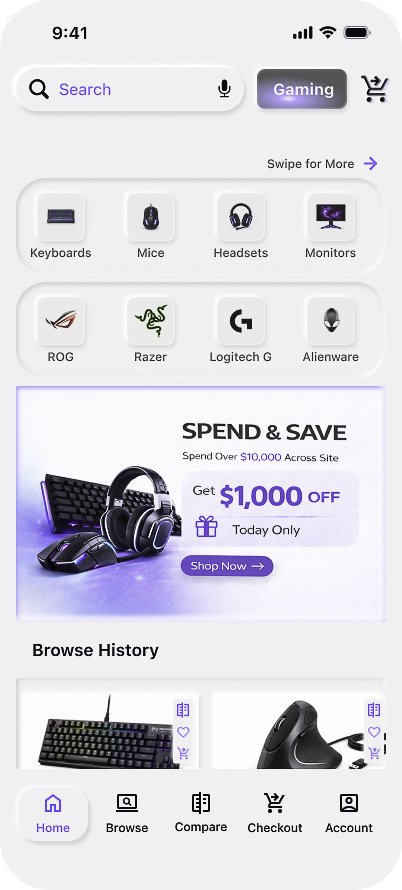
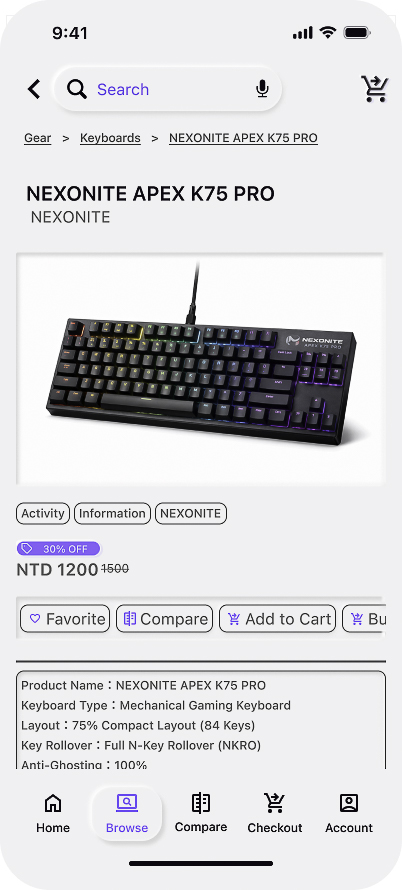
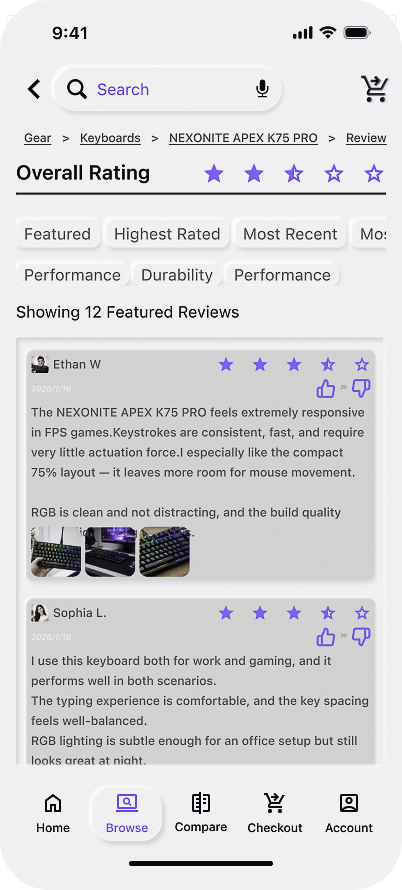
What if complex device specifications could become intuitive decision tools?
Overview
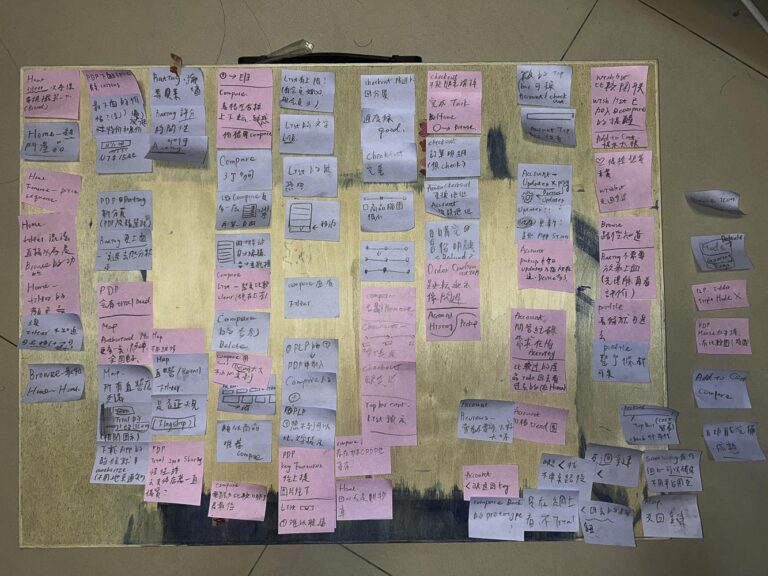
Before starting to design the Gamerlab APP, I’ve noticed the phenomanon on current ecommerce market: gamers evaluating hardware are facing fragmented information, inconsistent specifications, and time-intensive comparison workflows. High-cost purchase decisions require synthesizing multiple variables, yet existing tools do not support structured comparison.
What if complex device specifications could become intuitive decision tools?
I came up with the initial idea – a product concept designed to enable efficient, side-by-side evaluation of gaming devices through structured comparison and simplified data interpretation.
This is where Gamerlab started!
Role & Scope
Role: Product Designer (End-to-end)
Scope: Problem framing, UX process, interaction design, UI, validation, Feedback
If the complexity of comparing specifications between products is a phenomenon, what is the real problem?
Users are not lacking information — they lack structured comparison.
Key issues identified:
Device specifications are distributed across multiple sources
Metrics are difficult to interpret and compare directly
Decision-making is slow and cognitively demanding
Buyers rely on their own comparison behaviors before purchasing.
From the issues, the key insights are discovered:
Users prioritize decision efficiency over information depth
Raw specifications do not translate into actionable understanding
Comparison is a primary task, not a secondary feature
Product Strategy
Reframed the ecommerce selling platform to a comparison-first platform.
Core principles:
Enable direct comparison between multiple devices
Comparison tool should be connected to purchasing products.
Transform raw data into comparable, structured metrics
Reduce cognitive load through clear specification categories.
Design Decisions
Based on the product strategy, design decisions are made as listed:
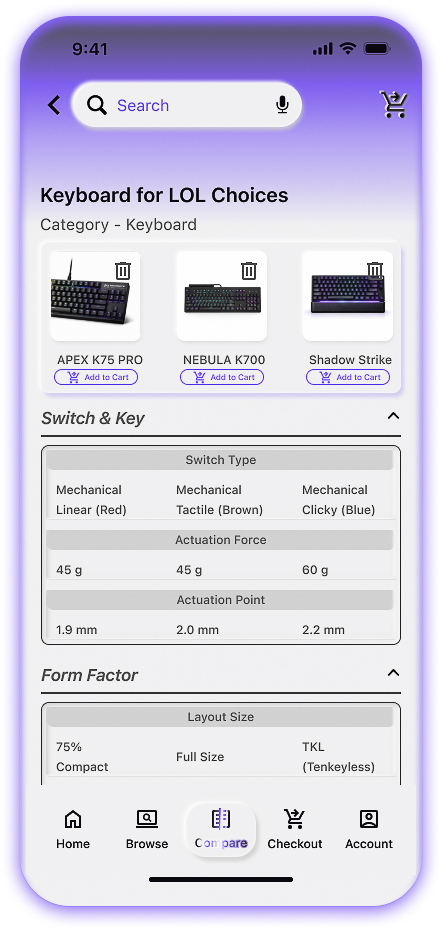
Introduced side-by-side comparison as the core interaction model
Standardized specifications into normalized comparison units.
Professional filter are priortized by users need between different gaming devices. (Like gaming mouse, DPI effieicncy is one of the main considerations)
Reduced non-essential sale promotion information to support faster and more reliable brand image.
Solution
Gamerlab now is a platfom that supports structured device evalution through:
Multi-device comparison interfacel
Normalized specification display.( on PDP)
Professional filtering and sorting on PLP
Clear visual hierarchy for comparison layers.
Outcome
Gamerlab enables:
Faster identification of preferred devices by detailed specifications determine process.
Reduced effort in comparing specifications through different app swapping.
Increased confidence in purchase decisions through professional brand image.
User validation indicated improved ability to:
Compare multiple options efficiently
Understand key differences without external tools
Lessons learned
When I initially tried to define the problem, I realized that real-world product challenges are not the same as isolated UX issues. User pain points only represent part of the picture; meaningful problem definition requires understanding the broader market context and how users make decisions in real scenarios. To address this, I conducted market research and competitive analysis to identify existing gaps and better position the product. This process led to the development of Gamerlab as a comparison-driven solution rather than a feature-focused app. Through user feedback on the final design, I further understood that product design is inherently iterative, and that effective solutions evolve continuously based on how users interact with and respond to the product over time.
The next steps are:
Integrate real-time pricing and availability
Introduce personalized recommendation logic
Expand comparison across broader gaming ecosystems